


Okay, I admit it. I’ve sometimes fantasized about getting into a capsule, being frozen until humanity invents the cure for the common cold (or for death, might as well aim high), and waking up in a world of hoverboards and perfect instant coffee. Cryonics is one of those topics that science fiction has sold us as a first-class ticket to the future. But what’s true about it? Is it physically possible? Is there anyone right now in a freezer? And while we’re at it, could we use it to travel to the stars without getting bored along the way?
Fasten your seatbelts, because we’re about to thaw out some answers. And also some chicken.
What is cryonics anyway?
First, let’s clear up some terms. When scientists talk seriously about this, they prefer to say cryopreservation. It’s not the same as freezing a steak. The idea isn’t to turn a person into an ice cube with legs, because the water inside cells, when frozen, forms crystals as sharp as knives that shred cell membranes. It would be like trying to bring a broken glass back to life after stepping on it. So the trick is to replace blood and fluids with a kind of anti-freeze cryoprotectant (glycerol, dimethyl sulfoxide… scary names) and cool the body to -196 degrees Celsius using liquid nitrogen. In that state, all chemical activity drops to nearly zero. No aging, no cell death… in theory.
The big problem: physics gets stubborn
Here comes the hard truth. Right now, physics says: “Sorry, tiger, but reviving someone who’s been cryopreserved is as likely as un-frying an egg.” The vitrification process (avoiding ice crystals) works pretty well for embryos, eggs, or small pieces of tissue. But in a human brain, with its trillions of ultra-fine synaptic connections, structural damage is unavoidable. Even if you avoid large crystals, microfractures form. Plus, the cryoprotectants themselves are toxic at certain concentrations. It would be like saving a phone from a pool by dipping it in sulfuric acid: sure, it doesn’t get wet, but it doesn’t work either.
And then there’s the big hurdle: the reverse process. We know how to cool things down, but heating a body evenly without it cracking or collapsing is something no microwave oven in the world can do. Not to mention repairing cell damage. So, from a pure physics standpoint, human cryopreservation today is irreversible with current technology.
Are there serious studies or is it all science fiction?
Yes, there are feasibility studies, and not all of them come from geeks in lab coats. Institutes like the Cryobiology Research Institute or 21st Century Medicine have managed to vitrify and successfully recover a rabbit kidney (it worked partially) and even mammal brains while preserving neuron structure. In 2015, a team managed to vitrify and rewarm a rabbit brain with synapses practically intact. The headline was “Frozen brain with no visible damage.” But don’t be fooled: “no visible damage under a microscope” doesn’t mean the rabbit started hopping again. We’re talking about tissue, not consciousness.
There are also studies with worms and mosquito larvae that survive freezing. But humans are bigger, more complex, and more demanding. It’s not enough for us to wiggle a little leg when thawed; we want to still be ourselves, with our memories and our habit of putting the toilet paper roll on backward (Yes, there’s a correct way to do it, look up the patent if you don’t believe me).
Is anyone cryopreserved right now?
Well, yes, though it’s not Walt Disney. Today, there are about 500 people and more than 200 pets (because, hey, if I freeze myself, my dog is coming too) in cryopreservation at facilities like the Alcor Life Extension Foundation (USA) or KrioRus (Russia). The most famous is Dr. James Bedford, a psychologist who in 1967 became the first human cryopreserved after dying of cancer. He’s still there, in a liquid nitrogen tank in Arizona, waiting for the 22nd century to figure out how to cure cancer and revive frozen corpses.
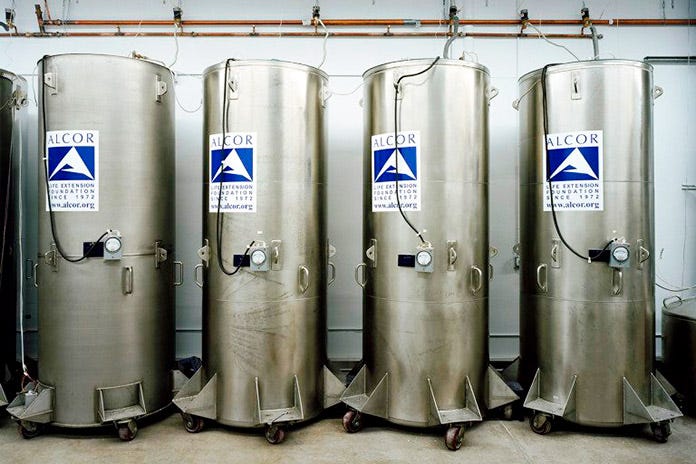
Important: they are not frozen alive. That’s illegal (and kind of brutal). Cryopreservation is applied after clinical death, under a somewhat fuzzy legal concept: the patient is legally dead, but it’s hoped that future science will reverse it. It’s like calling biology’s bluff.
Traveling through space frozen: genius idea or suicidal stupidity?
In movies like Alien or Passengers, we see hibernation capsules for interstellar travel. Does it make physical sense? Yes and no. On one hand, to get to Proxima Centauri (4 light-years away) with current engines, we’d need thousands of years. Freezing the crew would save food, oxygen, and sanity. But the problem is the same as before: recovery. Plus, cosmic rays in outer space damage DNA even when frozen. It would be like leaving yourself in the freezer for a millennium but with a neutron bomb inside. And then, when you wake up, you’d have more mutations than the three-eyed fish from The Simpsons.
However, there is a branch of research called induced hibernation (not freezing, but a state of torpor at 10-15 °C) that is being studied for missions to Mars. ESA and NASA are doing the math: reducing metabolism by 75% for 180 days is feasible. But from there to -196 °C… that’s a huge leap.
Hollywood and literature: the kingdom of lack of rigor
Here’s the fun part. As a science fiction writer, I plead guilty to giving in to temptation. The characters in my saga Project Orpheus travel on ships with cryonics capsules. But I also wanted to call science’s bluff and leave the door open to the possibility that by the 23rd century, humanity will have figured out how to make it work. After all, I won’t be alive to see if I’m wrong (Or maybe I will?).

Let’s name some other sinners:
Demolition Man: they freeze Stallone and Snipes in 1996 and thaw them in 2032 as if nothing happened. No brain damage. No muscle atrophy. But good old Sylvester wants to do some knitting. Fantastic.
Captain America: Steve Rogers spends 70 years frozen in the Arctic (in icy water, which is even worse) and wakes up with no lasting effects other than a little confusion. Physics cries in a corner.
Interstellar: Nolan uses cryogenesis with a bit more rigor (the tanks, reduced metabolism), but still, the characters spend decades hibernating without losing muscle mass or developing osteoporosis.
In literature, classics like George R. R. Martin’s Tuf Voyaging or Dan Simmons’ Hyperion series use hibernation as a narrative device without going into painful details. And I don’t blame them. Because the truth is that real cryonics is an ugly, uncertain, and probably irreversible process. But human beings need to dream about escaping death, even if it’s in an industrial freezer full of fish sticks.
Is it worth signing up?
Cryopreservation today is an act of faith, not science. It’s like buying a lottery ticket for a drawing that will happen 200 years from now, except that you’re already dead and the ticket is your vitrified corpse. The chances that future technology can reverse the damage are tiny. But they’re not zero. And that’s the hook.
If you’re a millionaire with $80,000 to spare (the price to cryopreserve your brain), go ahead. But if you want a more practical recommendation: better invest in eating well, exercising, and supporting anti-aging research with stem cells. Or, if you’re a science fiction writer like yours truly, keep writing stories where cryonics works. After all, imagination doesn’t need liquid nitrogen. Just a good plot and a little rigor… well… just enough so they don’t kick us out of the guild.
And you, would you freeze yourself to meet Bender in the year 3000? I think about it every time I see the price of gas. But then I remember that in the future there might be no chocolate or coffee, and the urge passes.