


You might be reading this short piece of science outreach on your phone while sitting on a bus, or maybe you’re at your desk or relaxing in your living room, tinkering with your laptop. There are many possibilities. But in all of them, there is something involved that has become a basic good in our society, something we already take for granted. I’m talking, of course, about the Internet connection.
Today it feels completely normal. We take our phone out of our pocket, send a message, watch a movie on streaming, or make a video call with someone on the other side of the planet. All in seconds. But not so long ago, this was science fiction.
The Internet did not appear out of nowhere. It is the result of decades of research, collaboration between universities, public investment, and many brilliant ideas. To understand how revolutionary it was, we first need to look at what communications were like before it existed.
Before the Internet: Cables, Switchboards, and Patience
Until the mid-20th century, long-distance communication was based on technologies such as the telegraph and the telephone. The telegraph sent coded signals (like Morse code) through cables. The telephone allowed people to speak in real time, but it depended on centralized and somewhat fragile networks.
If you wanted to send written information quickly, you used fax or telex (if you’re very young, these technologies may sound like something from prehistoric times). If you wanted to send large amounts of data… you simply couldn’t.
Communication networks were centralized. This means that if an important node failed (for example, a telephone exchange), a large part of the network could become useless. During the Cold War, this was a serious problem: what would happen if an attack destroyed the communication centers?
That’s where the real story of the Internet begins.
The Key Idea: A Decentralized Network
In the 1960s, during the tension between the United States and the Soviet Union, the U.S. Department of Defense created ARPA (Advanced Research Projects Agency) to promote advanced technological projects.
One of the key scientists was J.C.R. Licklider, from MIT. In 1962, he spoke for the first time about a “Galactic Network” where computers would be connected and could share information. It was an idea far ahead of its time.
Another fundamental name is Paul Baran, who proposed a decentralized network based on dividing information into small blocks that would travel along different routes. At the same time, in the United Kingdom, Donald Davies developed the same idea and coined the term “packet switching.”
The key was this: instead of sending a complete message through a single path, you divide it into small packets that can take different routes and be rebuilt at the destination. If part of the network failed, the packets could go around the damaged area. Something like a road network with many alternative paths.
The Birth of ARPANET (1969)
The project started under the name ARPANET.
The first universities connected were:
UCLA (University of California, Los Angeles)
Stanford Research Institute
University of California, Santa Barbara
University of Utah
The historic date was October 29, 1969.
That day, the first message was sent between UCLA and the Stanford Research Institute. The plan was to type “LOGIN.” The system crashed after sending only the first two letters: “LO.” So the first message in Internet history was literally “LO.” Almost poetic.
From that point, the network began to grow slowly. By 1971, there were already 15 connected nodes.
The Protocol That Changed Everything: TCP/IP (1973–1983)
For different networks to communicate with each other, they needed a common language.
This is where Vinton Cerf and Robert Kahn come in. In 1973, they developed the TCP/IP protocol. This set of rules allowed different networks to connect and form a “network of networks.” I won’t go into technical details, but it is the foundation that still supports our communications today.
January 1, 1983, is considered the “official birthday” of the Internet, when ARPANET adopted TCP/IP as its standard.
That was the moment when the Internet as we know it was truly born.
The First Email and the First Transoceanic Communication
In 1971, Ray Tomlinson sent the first email and decided to use the @ symbol to separate the user name from the server. A small detail that changed the world.
In 1973, the first transoceanic connection between the United States and the United Kingdom was established, expanding ARPANET beyond the American continent. The communication was carried out via satellite. The network was starting to become global.
The Creation of the World Wide Web (1989–1991)
Although the Internet already existed, it was not easy to use. You needed to know technical commands. There were no web pages as we know them today.
In 1989, at CERN in Switzerland, a British scientist named Tim Berners-Lee proposed a system to share information among researchers using hypertext.
That was the birth of the World Wide Web.
Berners-Lee created:
The HTML language
The HTTP protocol
The first web browser
The first web server
The first web page was published in 1991 and explained what the Web was and how to use it.
In 1993, the Mosaic browser made the Web visual and accessible to the general public. From that moment, growth became explosive.
Infrastructure: The Invisible Foundations
The Internet is not something floating magically in the air. It has always needed enormous physical infrastructure. From the beginning, it required:
Kilometers of coaxial cable
Data centers
Communication satellites
Later, fiber optic cables
Today, there are more than 1.3 million kilometers of submarine cables crossing the oceans. More than 95% of international data traffic travels through them.
In the 1970s, connection speeds were measured in kilobits per second. Today we talk about gigabits per second in homes and terabits per second in backbone connections.
In 1980, global data traffic was almost insignificant compared to today. Now, hundreds of exabytes move every month (an exabyte is one million terabytes).
The contrast is enormous.
From Four Nodes to Billions of Devices
In 1969, there were 4 connected computers.
Today, more than 5 billion people are connected to the Internet, along with tens of billions of devices (phones, computers, sensors, cars, home appliances…).
What began as a military and academic project is now the backbone of the global economy.
Internet in Literature and Film
Interestingly, while the Internet was being born, fiction was already imagining it.
In 1984, William Gibson published Neuromancer, where he coined the term “cyberspace.” His vision was dark, full of hackers and powerful corporations, but surprisingly close to reality in spirit. It is one of the works that most influenced our society, even though many people have never heard of it.
Movies like WarGames (1983) showed young people connecting to military networks through a modem. In Tron (1982), the main character literally enters the digital world.
In the 1990s, when the Internet was becoming popular, films such as:
The Net (1995), with Sandra Bullock, showed fears about digital identity.
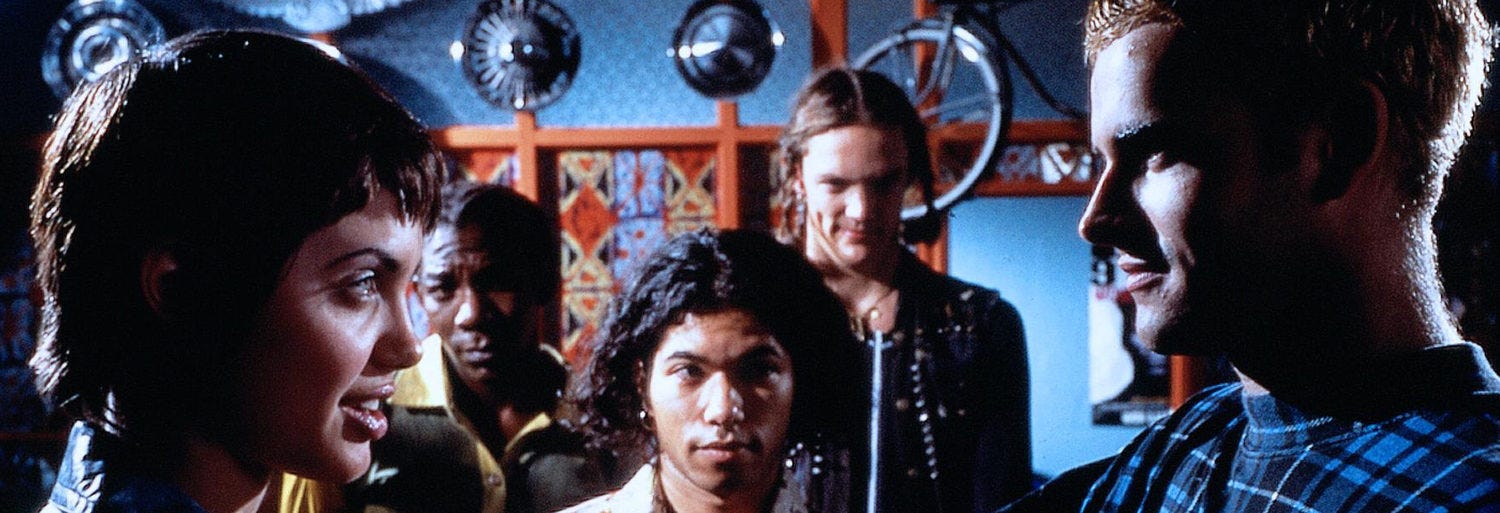
Hackers (1995) offered a very stylized and modern vision, although not very realistic.
The Matrix (1999) took the idea of virtual reality to a philosophical level.
Many of these works exaggerated technical abilities. Hacking is not about typing very fast with electronic music in the background. But they captured something real: we were entering a new era.
The Real Revolution
The great revolution of the Internet was not only connecting machines, but connecting people. It democratized access to information, created new industries, and changed the way we work, learn, and interact.
It has also brought problems: misinformation, addiction, mass surveillance, cybercrime. Like any powerful technology, it is neither good nor bad by itself. It depends on how we use it.
From that humble “LO” in 1969 to the billions of messages sent every second today, only a few decades have passed.
And if history teaches us something, it is that the biggest revolutions do not always begin with fireworks. Sometimes they begin with two letters and a computer that crashes.
“LO.”
And the rest, as they say, is history.