


You’ve probably seen worrying headlines at some point: “An asteroid the size of a building will pass close to Earth” or “NASA is tracking a potentially dangerous object.” When that happens, it’s hard not to imagine an apocalyptic scene: a huge rock falling from the sky, tsunamis, global fires, and mass extinctions. Hollywood has done a lot to feed that fear.
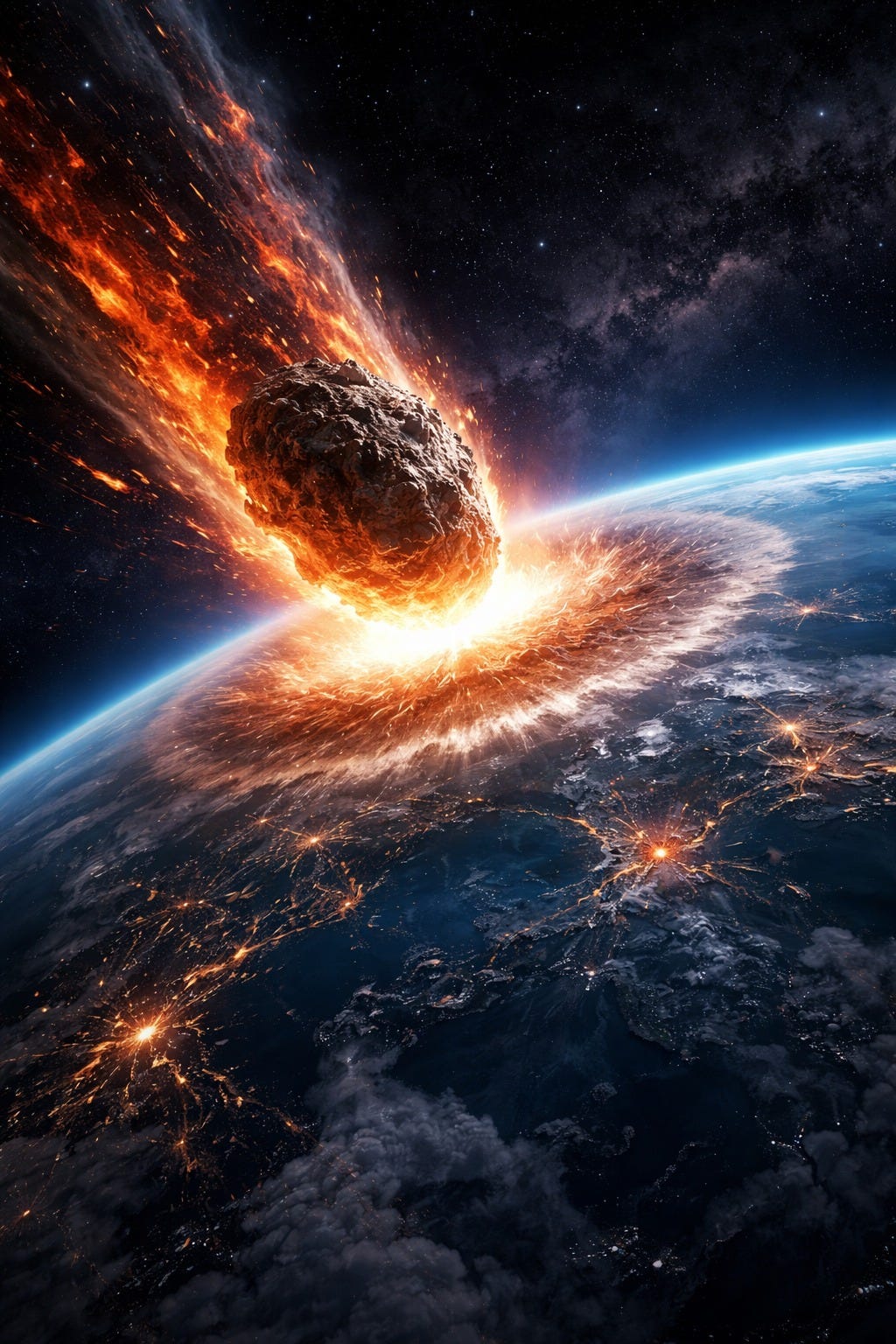
So the question makes sense: could something like that happen again? Should we be worried?
The short answer is yes, it could happen. But no, it’s not something that should keep us awake at night. The long answer is much more interesting, and it has to do with how our solar system works, the role played by some of its main actors, and what we’ve learned from the impact that wiped out the dinosaurs.
Let’s open that can of worms.
The asteroid belt: much less chaotic than it looks
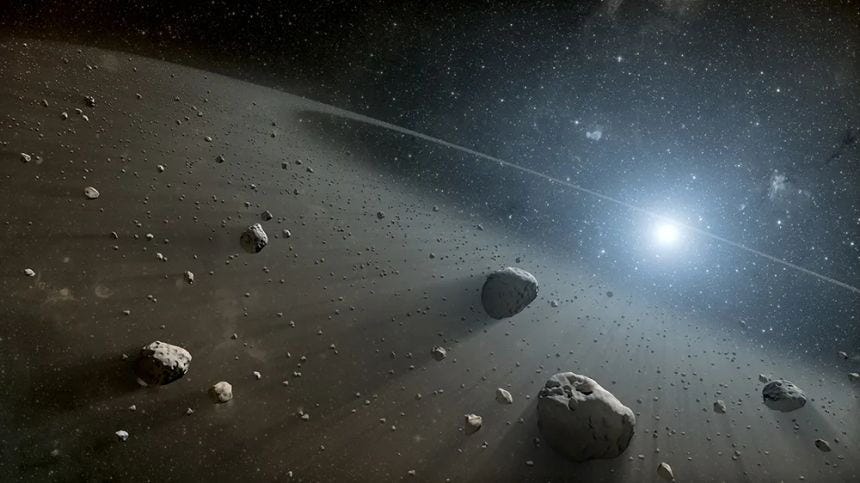
When we think about the asteroid belt, we often imagine something like a dense cloud of rocks floating everywhere, crashing into each other and spinning in all directions, like in Star Wars. The reality is far less dramatic.
The asteroid belt lies between Mars and Jupiter and contains millions of rocky objects of all sizes, from tiny dust grains to bodies hundreds of kilometers across. But the distances between them are huge. If you were there, chances are you wouldn’t see a single asteroid nearby.
So if they’re all calmly following their orbits and bothering no one, why do some of them end up coming close to Earth?
How does an asteroid get “pushed” out of its orbit?
Asteroids don’t usually change their orbits for no reason. It happens because of small disturbances that build up over millions of years. Several factors play a role here.
One of them is the gravity of the planets, especially Jupiter. Even though we’ll later talk about its protective role, Jupiter can also be a bit of a troublemaker. Its massive gravity can slightly alter the orbits of some asteroids in the belt, pushing them into more stretched, unstable paths.
Another important factor is the Yarkovsky effect. It sounds very technical, but it’s actually simple. An asteroid absorbs heat from the Sun and slowly releases it. That tiny thermal push, accumulated over millions of years, can change its orbit enough to move it out of a stable zone.
As a result, some asteroids become near-Earth objects. And “near” here is an astronomical term: even if something passes millions of miles away, it’s still considered part of the neighborhood.
The Sun and the gas giants: our cosmic bodyguards
Here comes the reassuring part.
The Sun is the main architect of the solar system. Its enormous gravity keeps most objects firmly locked into stable orbits. On top of that, solar radiation and the solar wind affect smaller bodies, making it less likely for them to settle into dangerous paths.
But the real heroes of this story are the gas giants: Jupiter and Saturn.
Jupiter, thanks to its immense mass, acts like a true gravitational shield. Many comets and asteroids that could otherwise reach the inner solar system are deflected, captured, or even flung out into deep space because of its influence. Without Jupiter, Earth would suffer impacts much more often.
That doesn’t mean Jupiter is perfect (as mentioned before, it sometimes sends one our way), but overall it protects us far more than it harms us. Think of it as a huge goalkeeper who occasionally scores an own goal, but who is still world-class.
The impact that ended the age of the dinosaurs
If we’re talking about asteroids, we can’t ignore the most famous one of all: the impact that happened about 66 million years ago and pushed the dinosaurs into extinction (or, at least, into becoming fossil fuel).
For a long time it was just a hypothesis, but today we know quite well what happened.
The asteroid, estimated to be about 6 to 7 miles wide, hit what is now the Yucatán Peninsula in Mexico, creating the Chicxulub crater, roughly 110 miles across.
The consequences were catastrophic:
An energy release equivalent to billions of nuclear bombs like those dropped on Hiroshima and Nagasaki.
Global earthquakes.
Massive tsunamis.
Worldwide fires caused by super-heated material falling back to Earth.
And above all, a global winter, caused by dust and aerosols blocking sunlight for years.
In fact, it wasn’t the impact itself that killed most species, but the collapse of ecosystems that followed.
How do we know all this?
This isn’t science fiction or wild guessing. We know about the impact thanks to solid evidence:
A global layer rich in iridium, an element rare in Earth’s crust but common in meteorites.
The crater itself, detected through geophysical studies.
Minerals deformed by extreme pressure, like shocked quartz.
Computer simulations that perfectly match the geological evidence.
We also know the impact happened during a time of intense volcanic activity, which likely made the climate crisis even worse.
Could something similar happen today?
Yes, but it’s extremely unlikely in the short or medium term.
Impacts of that size are very rare. They are thought to happen every tens or hundreds of millions of years. And today, we are far better prepared than any previous species to spot them early.
Right now, tens of thousands of near-Earth objects are being monitored, and we know about almost all of the ones that could cause a global disaster.
What could we do if we found a dangerous one?
This is where planetary defense comes in. It sounds like science fiction, but it’s very real.
Some of the ideas being studied include:
Kinetic impacts
Sending a spacecraft to crash into the asteroid to slightly change its orbit. The goal is not to destroy it, but to nudge it just enough. NASA’s DART mission has already shown that this can work… in principle. The main issue is time: you need many years of warning.
Nuclear explosions
Hollywood’s favorite option and the most problematic one. The idea is not to blow the asteroid into pieces (that could be even worse), but to vaporize part of its surface to push it off course. Technically possible, but politically and scientifically risky.
Painting it
It sounds silly, but it’s a real idea. Changing the asteroid’s color would affect how it absorbs sunlight and enhance the Yarkovsky effect. This only works over very long periods of time.
No matter the method, one thing is clear: early detection is the key if we don’t want to become fuel for some future intelligent species of cockroaches.
That said, there are good reasons to stay optimistic. We’re far more likely to face serious problems from climate change, pandemics, or human conflicts than from an asteroid.

Meteorites in movies and books
Hollywood loves asteroids. Movies like Armageddon, Deep Impact, or even Don’t Look Up have burned a very specific image of cosmic disaster into our minds. My main novel series is also inspired by all this, but in reality, it’s not quite so dramatic. It’s fiction, the kind we enjoy.
The most common mistakes are:
Detecting the asteroid just days before impact (in reality, it would be years).
Destroying it with an explosion and assuming the problem is solved.
Impossible trajectories and very creative physics.
Underestimating Jupiter’s role and the importance of early detection.
That said, some recent works, especially in hard science fiction, have been more careful, showing gradual deflection and real uncertainty.
Meteorites have changed the history of life on Earth, and they could do so again. But today, for the first time, a species is aware of the danger and is starting to build tools to deal with it.
That doesn’t make us invulnerable, but it does make us far less helpless than the dinosaurs.
So the next time you see an alarming headline about a “potentially dangerous” asteroid, remember this: space is vast, the solar system is surprisingly well organized, and we have two giant gas planets watching our backs.
And that, all things considered, is pretty reassuring.